Slander
Much Ado About NothingSlander is not merely an insult in the play but a social weapon that converts appearance into judgment. It travels through overheard conversations, hostile reports, darkened spaces, and public accusation, making a false story seem more authoritative than the person it condemns. Its decisive power lies in the way it joins deception to the culture of honor: once Hero’s reputation is treated as damaged, her family, her intended marriage, and finally her life are placed under the pressure of that invented account.
Definition and First Transmission
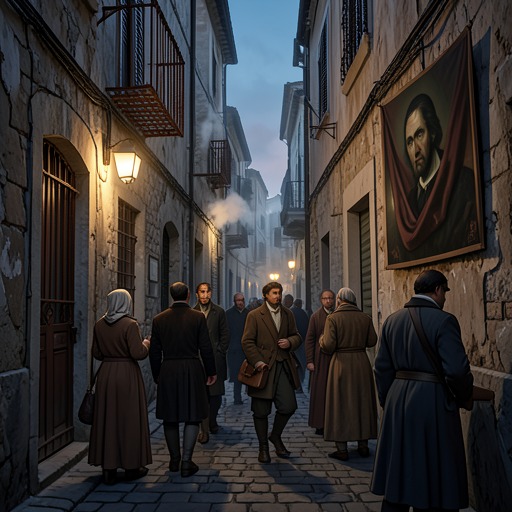
The play presents slander as information whose apparent credibility exceeds its truth. Antonio’s report about the prince and Count Claudio is based on what one of his men overheard in a thickly planted alley in Leonato’s orchard. The account says that the prince loves Hero, intends to acknowledge the love at a dance, and will immediately approach Leonato if she accepts him. This report is not itself malicious, but it establishes the larger pattern: private speech is intercepted, transmitted to others, and treated as a basis for action before its meaning has been tested.
The same structure is then turned toward destruction. Borachio describes how he hid behind an arras while acting as a perfumer and heard the prince and Claudio agree that the prince would woo Hero for himself and, after winning her, give her to Claudio. Don John takes this overheard material as food for his displeasure and asks Borachio to help him cross the prince. Slander therefore begins not with an openly witnessed fact but with selective hearing and hostile interpretation; the listener’s purpose determines whether concealed speech becomes useful knowledge or an instrument of injury.
Manufacture Through Appearance
Don John’s scheme depends on making jealousy look like certainty. Borachio is instructed to draw Don Pedro and Claudio into a private meeting and tell them that Hero loves Borachio. He is to present the accusation as an act of zeal for the prince’s honor and Claudio’s reputation, claiming that the proposed match rests on the semblance of a maid. The intended witnesses must be shown apparently confirming details: Borachio at Hero’s chamber window, calling Margaret by Hero’s name, while Margaret calls him Claudio. The plot is designed so that an arranged scene will supply the visual and verbal signs that suspicion demands.
The deception reaches its most dangerous form on the night before the wedding. Borachio arranges for Hero to be absent while Margaret appears at the chamber window in circumstances that resemble an illicit encounter. From a distance, in darkness, the prince and Claudio see Margaret but believe her to be Hero. Borachio later explains that Don John knew the truth, while the prince and Claudio were misled by his oaths, by the dark night, and chiefly by his villainy, which confirmed the slander already planted in their minds. The scene thus demonstrates that slander does not require a wholly invented image; it needs only a real image placed under a false name and interpreted through prior suspicion.
The rhetoric of the scheme is equally important. Borachio presents himself as the defender of honor, reputation, and the purity of a marriage, while concealing that he is producing the evidence himself. His account borrows the authority of moral concern, so that the accusers can imagine themselves acting responsibly even as they become instruments of Don John’s design. The result is a counterfeit chain of proof: rumor supplies the premise, staged observation supplies the appearance of confirmation, and the emotional force of jealousy supplies the conviction.
Public Accusation and Social Consequences
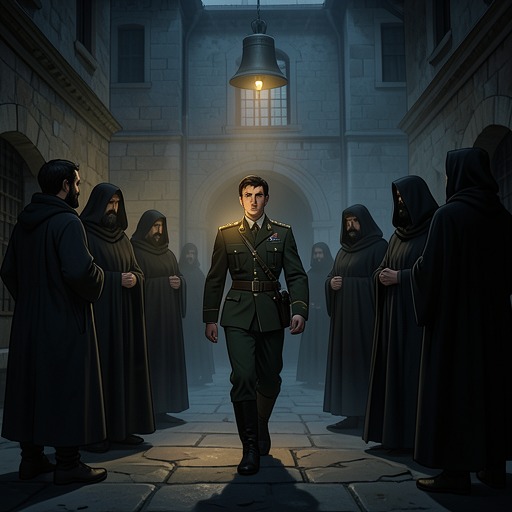
Claudio converts the manufactured evidence into a public sentence. He swears that he will meet Hero at the temple on the following morning and shame her before the entire congregation, sending her home without a husband. The intended wedding therefore becomes the chosen theatre of slander. A private deception is not allowed to remain private; its purpose is to expose, disgrace, and socially isolate the woman whom the false story targets.
At the ceremony, the accusation is framed as a judgment on Hero’s inner character rather than as an uncertain report. Claudio addresses her as though outward beauty has concealed inward corruption, asking what man spoke with her at her window between twelve and one. The charge is supported by testimony that someone saw and heard her speaking with a ruffian at her chamber window, and by the villain’s supposed confession that he had repeatedly met her in secret. These details give the accusation a precise hour, location, witness, and alleged admission. Their specificity makes the falsehood more damaging: the story appears too circumstantial to be dismissed as mere rumor.
Slander also produces a crisis of honor among the men who believe it. Don Pedro declares himself dishonored for having tried to join his dear friend to a common stale, treating the alleged sexual conduct as a stain on his own judgment and patronage. Leonato’s response reveals the scale of the wound within the family. He thanks the princes for his daughter’s death and asks that their act be recorded among their high deeds, bitterly calling it brave if they will remember what they have done. The false accusation has therefore changed relationships before its truth can be examined: a proposed marriage becomes a public repudiation, paternal trust becomes grief, and political honor becomes an excuse for irreversible judgment.
Discovery and Retraction
The play eventually exposes slander through a countercurrent of testimony. The Sexton reports that Prince John has secretly fled, that Hero was accused and refused in exactly the manner now being discussed, and that she died suddenly from grief. This report initially confirms the apparent tragedy, but it also directs attention toward the arrested men and the examination that can reveal how the accusation was made. The truth emerges not from the powerful observers’ first interpretation but from evidence gathered by the Watch and preserved in a formal record.
Borachio’s confession supplies the decisive reversal. He admits that he deceived the prince and Claudio’s very eyes, and that what their wisdom could not discover was brought to light by the supposedly shallow fools who overheard him confessing to Conrade. He identifies Don John as the person who incited him to slander Hero, explains that the prince and Claudio were brought into the orchard to see him court Margaret in Hero’s garments, and acknowledges that the false scene caused Hero’s disgrace at the moment when she should have been married. The confession restores the distinction between seeing and understanding: the noblemen saw an event, but the watchmen and the accused speaker reveal what that event meant.
Borachio also accepts responsibility for the consequences. He records his villainy, states that Hero is dead through the false accusation made by him and his master, and asks for nothing but the reward due to a villain, preferring death to the continued repetition of his shame. His confession does not undo the damage; it establishes the truth after the victim has already suffered its most extreme consequence. Slander is thus shown to be temporally asymmetric. A lie can produce death before a confession can produce knowledge.
Meaning and Narrative Function
The concept organizes a sustained contrast between reputation and reality. Hero’s visible conduct is made to signify something false because the observers already possess a story supplied by Don John. Claudio’s language treats the alleged appearance as proof of an inward nature, while the later confession shows that the same appearance was manufactured through costume, darkness, naming, and distance. The play’s crisis depends on the gap between what is seen, what is said about what is seen, and what actually occurred.
Slander also exposes the fragility of honor when honor depends on public recognition. The accusation is powerful because it threatens not only Hero’s private virtue but the standing of Claudio, Don Pedro, and Leonato before the community. Beatrice responds to this social violence by calling Claudio a villain who has slandered, scorned, and dishonored her kinswoman, imagining a direct and bodily form of revenge against the man who has converted speech into injury. Her anger makes clear that slander is experienced as an assault requiring redress, not as a harmless error of language.
Finally, the plot assigns the exposure of the lie to an unexpected source. The prince and Claudio possess rank, intelligence, and direct visual access, yet they are defeated by the performance they believe they understand. The low-ranking Watch, through accidental overhearing and official examination, brings the concealed mechanism into the open. Slander therefore functions as both theme and plot engine: it drives the marriage toward public catastrophe, reveals how authority can be manipulated by plausible appearances, and makes truth depend on patient verification rather than status, confidence, or the force of a dramatic accusation.